
Before I kept books for a living, I co-owned a Spanish tapas bar and restaurant.
People said the space was cursed. No business could survive there, they said. In our first two years we were named the number one new hot spot twice.
I managed the servers, and I kept the books. I'd done some bookkeeping before, for businesses I was trying to get off the ground. I didn't understand how a restaurant's books should be built.
There was a lot of money in the bank. The books said otherwise.
I knew something was wrong the whole time. It felt awful, because we were bringing in a new co-owner, someone with restaurant experience in the area, and I couldn't show him numbers I trusted. I fixed a lot of it myself. Then I paid a bookkeeper to fix what I couldn't, and to fix what I'd broken trying.
That was my first cleanup. I was young, and I got thrown in the deep end.
It's where I learned that real growth can't happen without clean books. You can't decide to hire, expand or bring in a partner when you don't know what you have. It's like having your feet stuck in quicksand. Every move you make could be your last.
Two numbers that answer different questions
Profit tells you whether the work made money. Your bank balance tells you how much money is there right now. They almost never match, and either one on its own can fool you.
When profit is bigger than the bank
This is the one most owners run into. The profit and loss says you had a great month, and the bank account doesn't show it. The money is usually in one of four places:
- Customers who haven't paid you yet.
- Inventory you bought and haven't sold.
- Loan payments. Only the interest shows up as an expense. The rest of each payment leaves the bank without touching profit.
- What you took out for yourself.
Here's an example with made-up numbers.
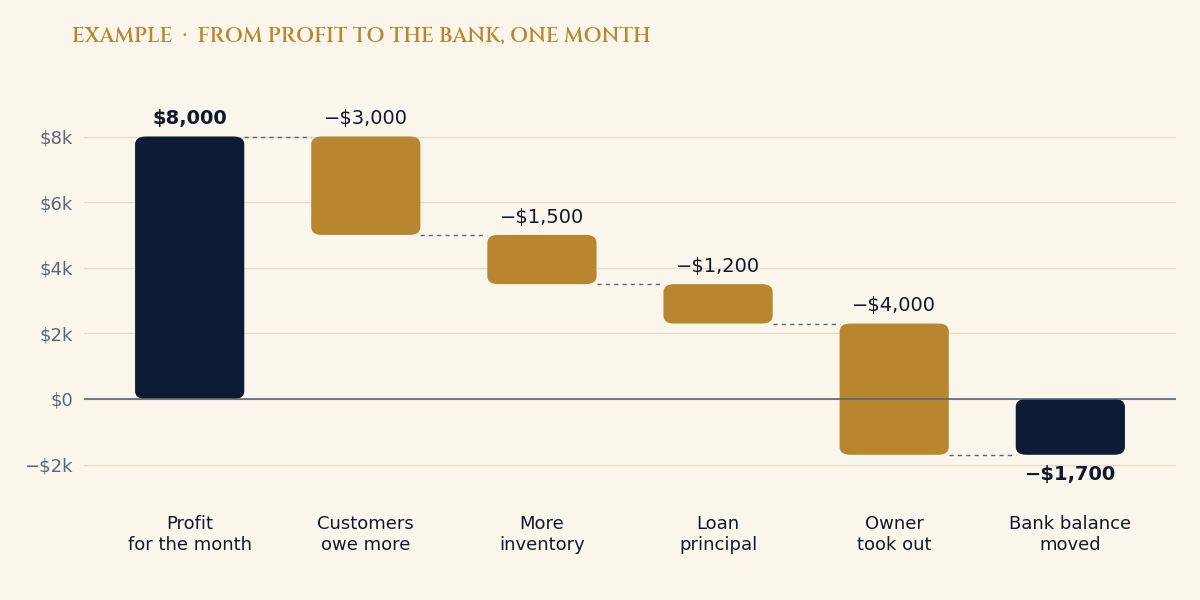
An $8,000 month, and $1,700 less in the bank. Nothing is wrong with those books. The money went somewhere real, and now you can see where.
When the bank is bigger than the profit
That was me. Some of it can be real. Money can sit in your account that isn't yours yet: GET you've collected and not paid, payroll taxes you've withheld, bills you haven't paid, gift cards sold for meals you haven't served.
And sometimes the books are just built wrong. You can't see that from the profit and loss. You see it when you build the bridge between the two numbers and one piece doesn't make sense.
Try It: The Bridge
- Run a Profit and Loss for last month and write down Net Income.
- Run a Balance Sheet for last month. Click Compare, choose Previous period, and turn on $ change. Find your bank accounts. The $ change on them is how much your cash moved.
- Go down the $ change column for everything else, skipping Net Income near the bottom, since that's the profit you started with. Each line that moved is part of the bridge. Customers owing more, inventory going up, loans going down and money you took out all mean less cash than profit. GET, payroll taxes and bills you owe going up mean more.
Here's the part most people don't know. In QuickBooks the bridge always adds up, because every entry has two sides. So the test isn't whether it adds up. The test is whether every line on it is something real. If Undeposited Funds keeps growing month after month, or Opening Balance Equity or anything with Uncategorized in the name moved at all, that's where your books are wrong.
Can't make the bridge add up to something real? The free diagnostic is where I'd start.
About the Free Diagnostic