
At the restaurant I wrote about in Two Numbers: Profit and Cash, I ran the servers. Most of my job happened before the doors opened. Every day, I got the floor set up for service.
Once the doors open, there's no time to go looking for anything. Kitchens have a name for having everything ready first: mise en place. Everything in its place.
The books got my attention too, behind closed doors, at least once a week. Back then they weren't as important to me as the floor. They are now.
Most businesses open the doors first
Here's how money works in a lot of small businesses. A deposit lands. The account looks healthy, so some of it gets spent. Then payroll comes due, then the GET return, then a bill nobody remembered. Each one gets paid from whatever is left.
That's opening the doors before you've set up. Every dollar arrives without a job, and the jobs show up later looking for it.
Give every dollar a job when it arrives
Setting up means deciding ahead of time where each deposit goes. You pick a split once, and every deposit gets divided the same way.
Here's an example with made-up numbers.
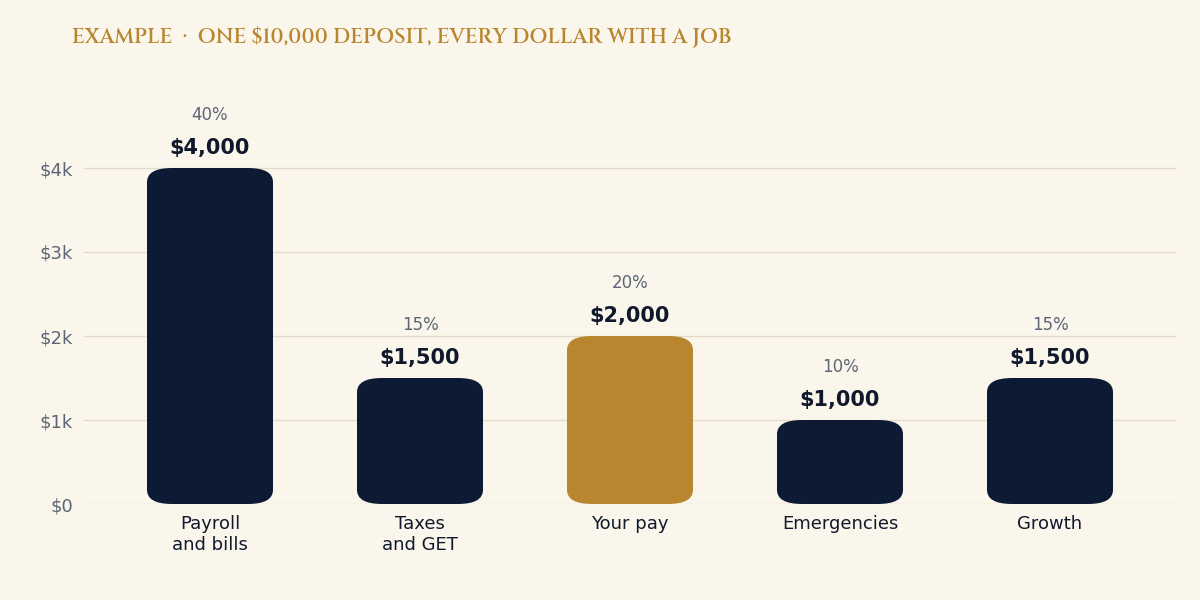
Payroll and bills is what it costs to run the business. Taxes and GET is money that was never yours. Your pay is a set amount you pay yourself on a set day. Payday for the Owner is about picking it. Emergencies is the cushion for a slow month or a broken oven. Growth is money set aside on purpose for the next hire, the next piece of equipment or the next idea.
Your percentages won't look like these. A business with a big payroll needs a bigger first slice. What matters is that every dollar has a job before anyone spends it.
Make it real with separate accounts
A split on paper is easy to ignore. A split in separate bank accounts is hard to ignore.
Start with one. Open a savings account for taxes and GET, and move that slice there every time a deposit lands. When the return is due, the money is already sitting there. Once that habit sticks, add an account for emergencies.
Try It: The Split
- Find your last big deposit, or last month's total deposits.
- Split it on paper into five jobs. For payroll and bills, look at what the business spent on them over the last three months and figure out what share of your deposits that was. For taxes and GET, start with 4.5 percent for GET and ask your CPA what to set aside for income tax. For your pay, pick an amount you could count on every month. Payday for the Owner helps you get it right. Give emergencies and growth something, even if it's only a few percent.
- Add up the five. If they come to more than the deposit, something has to give, and it's better to find that out on paper than in the bank.
Healthy is every dollar of that deposit with a job, and the tax money somewhere you won't spend it.
Want help setting up the split in your own books? It starts with the free diagnostic.
About the Free Diagnostic