
Debt with no end date starts to feel permanent. You make the payments, the balances barely move, and after a while it feels like part of the business, the same as rent.
Debt with an end date is a plan. You know which month holds the last payment, and every month you can see it getting closer.
Here's an example. It's a made-up business with three debts:
- A business credit card: $12,000 at 24 percent, with a $360 monthly payment
- A line of credit: $6,000 at 11 percent, with a $150 monthly payment
- An equipment loan: $18,000 at 7.5 percent, with a $600 monthly payment
That's $36,000 in all, and $1,110 a month in payments.
Three ways to pay it off
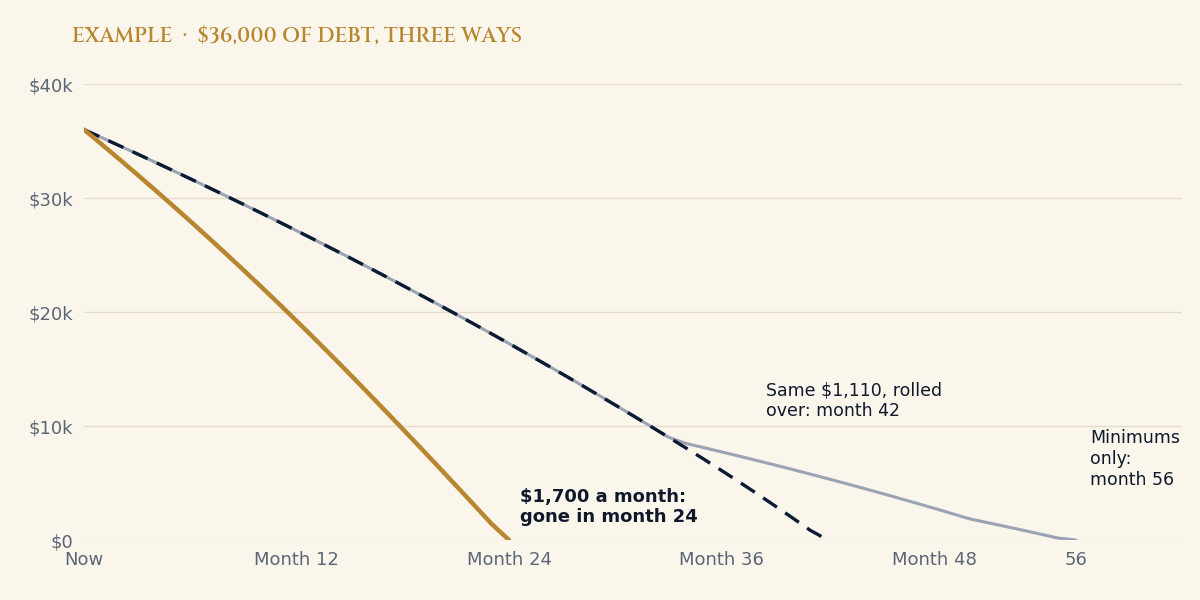
If the owner pays only those amounts, and each payment simply stops when its debt is gone, the last payment lands in month 56. That's almost five years, and about $11,500 in interest.
If the owner keeps paying the same $1,110 a month, but moves each finished payment onto the next debt, the last payment lands in month 42. That's more than a year sooner and about $1,100 less interest, without paying a dollar more each month.
If the owner raises the total to $1,700 a month, the last payment lands in month 24. Interest drops to about $4,500, almost $7,000 less than paying only the minimums.
Which debt to pay first
When there's money beyond the minimums, it has to go to one debt first. There are two usual choices.
Pay the highest interest rate first. Here that's the credit card. It costs the least, and it's what the $1,700 plan above does.
Pay the smallest balance first. Here that's the line of credit, which is gone in month 9 instead of month 19. That early win helps some people stick with the plan. In this example it costs about $800 more in interest and one more month.
Either one works. The plan you actually keep beats the one that looks best on paper. What matters is choosing the order on purpose and knowing the date.
Try It: Your Payoff Date
I made a free Debt Payoff Date sheet. Put in your debts and what you can pay each month, and it shows the month each one is paid off and how much interest you'll pay along the way. It has this example filled in, so you can switch the order and watch the date move. No sign-up, and it collects nothing.
- List every debt the business owes, with the balance, the interest rate and the monthly payment. All three are on each statement. Leave off any card you pay in full every month.
- Decide how much the business can put toward debt each month. If you built the 13-week forecast, check that the amount still fits your tightest week.
- Put both into the sheet and read the date. Then add $100 to the monthly amount and see how many months closer it comes.
Write that month down somewhere you'll see it.
P.S. When a debt is paid off, move its payment to the next one that same month. If it drifts back into everyday spending, the date slips.
Want a payoff plan built on numbers you can trust? Start with the free diagnostic.
About the Free Diagnostic