
Surfers here check the swell forecast before they paddle out. It won't tell them the size of every wave. It tells them what's coming and roughly when, early enough to plan the day around it.
Most businesses have nothing like that for their bank account. They find out payroll is tight the week payroll is due.
A 13-week cash forecast is the swell forecast for your bank account. It's a simple list, one column per week, of the money you expect to come in and go out. Thirteen weeks is about three months. That's far enough ahead to see the big payments coming, and close enough that most of the numbers are ones you already know.
How it works
Each week has four lines: what you start with, what comes in, what goes out, and what's left. What's left at the end of one week is what you start the next week with.
What comes in is the money you expect customers to actually pay that week. Use when they usually pay, not when the invoice is due. If a customer always pays three weeks late, put it three weeks late.
What goes out is everything you already know about: payroll, rent, loan payments, credit card payments, insurance and your GET return. Most of these are the same every month, so after the first time it's mostly copying.
Find your tightest week
Once it's filled in, look along the bottom line for the lowest number. That's your tightest week, and now you know about it weeks ahead instead of the morning it arrives.
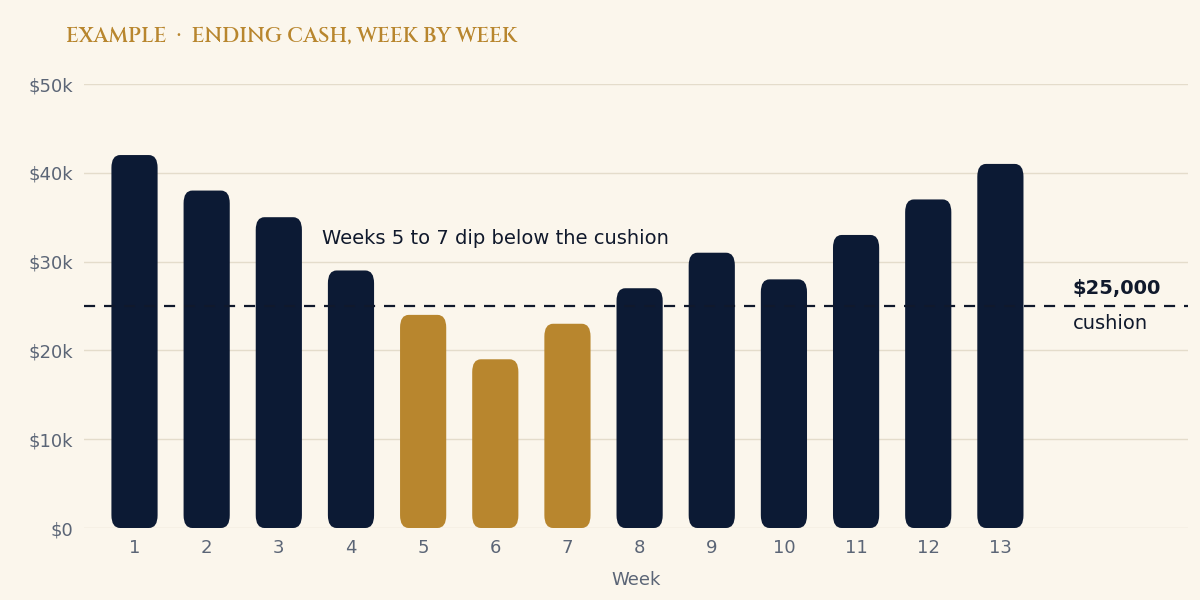
In this example, the owner wants to keep at least $25,000 in the bank. The balance drops below that in weeks five through seven. Seen five weeks early, that's easy to handle. Ask a customer to pay an invoice sooner, push a purchase back a few weeks, or plan to take a little less out of the business for those weeks. Seen the Monday it happens, there aren't good options left.
Keeping it up takes about fifteen minutes a week. Replace this week's guesses with what actually happened, and add a new week on the end. After a month or two your guesses get better, because you can see where they were wrong.
Try It: The Next Four Weeks
I made a 13-week forecast you can download for free. It has an example already filled in so you can see how it works, and a blank one for you. It's a plain spreadsheet. No sign-up, and it collects nothing.
- Put your bank balance today into week one.
- Fill in just the next four weeks: what you expect to come in and what you expect to go out.
- Find the lowest of those four weeks. Is it above the amount you'd want to keep in the bank no matter what?
Four weeks is enough to start. If one of them surprises you, the forecast is already doing its job.
P.S. A forecast is only as good as the balance it starts from. If the bank check in The Touchstone showed a gap, fix that first.
Want a forecast that starts from a balance you can trust? Start with the free diagnostic.
About the Free Diagnostic